
Key Takeaways
- Effective performance reporting is not just about calculating returns; it's about creating a conversation tool that connects portfolio outcomes to client goals.
- The choice between Time-Weighted (TWR) and Money-Weighted (MWR) returns can significantly alter the number a client sees, creating communication challenges if not presented with context.
- Data quality issues, such as custodial data latency and multi-custodian reconciliation gaps, can quietly erode client trust in the accuracy of performance reports.
- For complex clients with multiple entities and accounts, household-level reporting can be important for providing a more complete picture of their wealth, as account-level views may not reflect how these clients think about their financial position.
- As firms grow, establishing firmwide reporting governance for templates, disclosures, and benchmark usage becomes a critical discipline for ensuring consistency and scalability.
Many wealth management performance reports are technically accurate, but they do not always help advisors have better client conversations. The numbers may be correct, the benchmarks may be included, and the disclosures may be present, yet the report often sits on the table during a review meeting while the advisor explains the portfolio from memory or a separate set of notes. This reflects a persistent tension in the industry: the gap between generating a performance report and using it as a conversation tool is where many firms lose time, consistency, and client clarity.
That challenge also intersects with a separate workflow that matters earlier in the client lifecycle: comparative portfolio analysis for prospects and newly gathered accounts. Ongoing performance reporting is typically handled within a portfolio accounting or reporting system, while comparative analysis is about turning existing statements and holdings data into objective insights that can support a client-ready discussion. Examining the methodology choices, data quality, household-level complexity, and reporting governance behind wealth management performance reporting helps clarify where ongoing reporting systems fit, and where comparative analysis platforms such as VRGL support acquisition and engagement workflows without replacing those systems.
What Performance Reporting Needs to Accomplish Beyond Return Calculations
Performance reporting in wealth management serves a fundamentally different purpose than performance measurement in institutional asset management. For an institutional investor, the report is an accountability document. For a wealth management client, the report is a conversation starter and often the only tangible artifact of the advisory relationship between review meetings.
Consider this illustrative scenario: an advisory firm recently consolidated three acquired practices. Within two quarters, the operations team discovered that one legacy practice was generating time-weighted returns gross of advisory fees while the other two were reporting net of fees, and a third subset of accounts was pulling benchmark comparisons from a stale index feed. No single report was mathematically wrong, but a client holding accounts across two of the legacy books received quarterly statements that told conflicting stories. The inconsistency surfaced during a review meeting, and the conversation shifted from strategic advice to data reconciliation.
This gap is not a technology problem in isolation; it reflects a workflow disconnect. An effective wealth management client reporting process must bridge the analytical output with the conversational context. It needs to address not just the return number, but also benchmark relevance, risk-adjusted perspective, fee transparency, and alignment with the client's stated objectives. The quality of a performance report is determined less by its computational precision and more by how well it equips an advisor to explain portfolio outcomes in terms the client actually cares about.
Return Methodology Choices and Their Impact on Client Perception
The debate over Time-Weighted Rate of Return (TWR) versus Money-Weighted Rate of Return (MWR) is a staple of finance education, but its practical implications for client conversations are often overlooked. The choice of methodology directly changes the number on the report, and that number shapes how a client perceives their portfolio's success and their advisor's contribution. Understanding this is not about turning clients into financial analysts; it is about anticipating the questions that arise when the report on the table does not match the client's mental math.
When TWR and MWR Tell Different Stories About the Same Portfolio
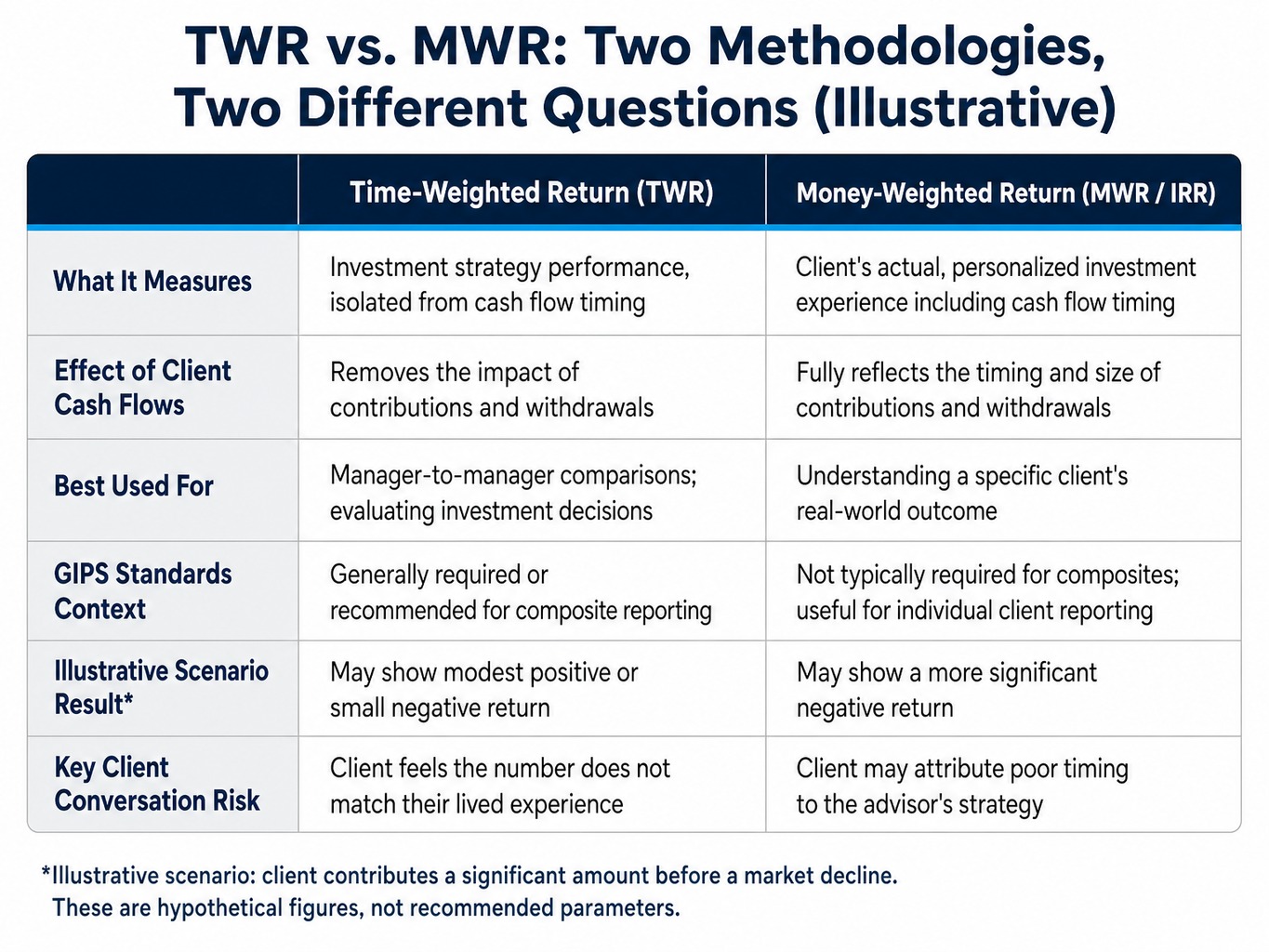
The core distinction between the two primary return methodologies is straightforward. TWR isolates the performance of the investment strategy by removing the distorting effects of client-driven cash flows. MWR, often expressed as an Internal Rate of Return (IRR), reflects the client's actual, personalized experience, including the timing and size of their contributions and withdrawals.
Neither is more "correct" than the other; they answer different questions. However, the divergence between them is often greatest when a client has made large contributions or withdrawals, which means the methodology choice can matter most for clients who are most actively engaged with their portfolios.
For example, consider this hypothetical scenario: a client contributes a significant amount to their portfolio shortly before a market decline. Depending on the timing, size of the contribution, and return path before and after the cash flow, TWR and MWR may diverge meaningfully.
- TWR may show a modest positive return, a small negative return, or a result similar to MWR, depending on how returns were distributed across the measurement period.
- MWR may show a more negative result if the larger balance was exposed to the downturn soon after the contribution, but the outcome will vary based on the magnitude and sequence of returns and cash flows.
The CFA Institute's GIPS Standards often use TWR in composite reporting contexts, but the applicable requirements can vary based on asset class, composite type, and the specific provisions involved. For an individual client conversation, MWR can sometimes offer a more intuitive measure of the client's personal investment experience.
Presenting Methodology-Driven Differences to Clients
Most clients do not need to understand the mechanics of return calculations, but they will notice when a report shows a number that feels disconnected from their experience. An advisor may face questions about why the portfolio's reported return does not seem to align with the change in account value shown on a custodial statement. This common discrepancy often stems from the interaction between the chosen return methodology, the timing of cash flows, and how fees are netted.
An advisor's ability to navigate this conversation depends on the clarity of the report itself. Firms may want to consider whether their investment performance reporting provides enough context to bridge this gap. Including elements like beginning and ending market values, net contributions and withdrawals, and investment income can help clients reconcile the calculated return figure with the activity in their account. The goal of methodology transparency is not to deliver a math lesson but to reduce the conversational friction that unexplained discrepancies can create, allowing the focus to remain on strategy and planning.
Read more: Wealth Management Proposal Software in 2026: What the Feature List Doesn't Tell You
Where Performance Data Quality Erodes Before It Reaches the Client
Even with a sound methodology and well-designed templates, the trustworthiness of a performance report is closely tied to the quality of the underlying data. This operational layer, sitting between the custodian and the client-facing output, is where small inconsistencies can arise and quietly undermine a report's credibility. These data quality challenges tend to compound in firms that work across multiple custodians or report on held-away assets , making data reconciliation a critical discipline for scalable wealth management performance reporting .
Custodial Data Latency and Stale Pricing
Custodial data feeds do not always update in real time. Depending on the custodian, the asset type, and the feed schedule, there can be a lag of hours or even days in the posting of transactions, corporate actions, and final pricing data. Classification differences, such as a security being categorized differently by the custodian and the analytics engine, can affect portfolio categorization, asset allocation views, and sector exposure reporting without necessarily changing calculated returns. By contrast, transaction posting gaps, missing corporate actions, and stale or incorrect pricing can directly affect performance calculations.
In an illustrative example, an advisor generates a quarterly report on the first business day of the month. The custodial feed, however, has not yet reflected final-day pricing for certain alternative or fixed-income holdings. The report is sent to the client with stale prices, and the resulting return figure differs slightly from what the client sees when they log into their custodial portal the next day. Even a small discrepancy can introduce a seed of doubt, forcing the advisor to spend time explaining data lags instead of discussing portfolio strategy. Firms may want to evaluate their data feed timing and stale price flagging procedures as part of their reporting quality control.
Multi-Custodian Reconciliation Challenges
Advisory firms that serve clients with assets at multiple custodians, a common scenario for UHNW families and firms that have grown through acquisition, face another layer of complexity. Different custodians may classify assets differently, use different pricing sources, or post transactions on varying schedules.
When a firm aggregates this disparate data into a single household-level report, reconciliation gaps can emerge. A security might be classified as "Technology" by one custodian and "Communication Services" by another, distorting consolidated asset allocation charts even if the return numbers are correct. In other cases, transaction timing differences or pricing discrepancies can change both the holdings view and the calculated performance results. Manually resolving these exceptions for every reporting period can consume significant operational capacity and introduce the risk of error. For firms scaling across multiple custodial relationships, multi-custodian reporting is not just a data aggregation problem; it is a persistent reconciliation discipline.
Household-Level Reporting and What Complex Clients Need to See
Account-level performance reporting, the default for many platforms, does not reflect how most complex clients think about their wealth. A family with taxable accounts, retirement accounts, trusts, and other entities does not evaluate their financial position one statement at a time. They want to understand how their total portfolio is performing, how assets are allocated across the entire household, and where concentrations or gaps exist.
In an illustrative case, a family office client with accounts spread across three custodians and two different trust structures receives a stack of individual account-level reports. Each is accurate on its own, but none provides the consolidated household view needed to answer the client's primary question: "How are we doing?" The advisor is left to manually assemble a summary in a spreadsheet before the review meeting, a time-consuming process that introduces the potential for error.
Providing a complete household-level view requires more than just data aggregation. It demands a reporting framework built on consistent asset classification, unified benchmark assignment, and a presentation layer that can accommodate complex ownership structures. For example, a blended benchmark that accurately reflects a household's target allocation may not match any single account's benchmark, creating a situation where the household report and the account reports tell different stories even when both are technically correct. This is a particularly relevant consideration for firms serving UHNW families and multi-generational wealth, where a reporting system must support a consolidated perspective.
Reporting Governance as a Firmwide Discipline
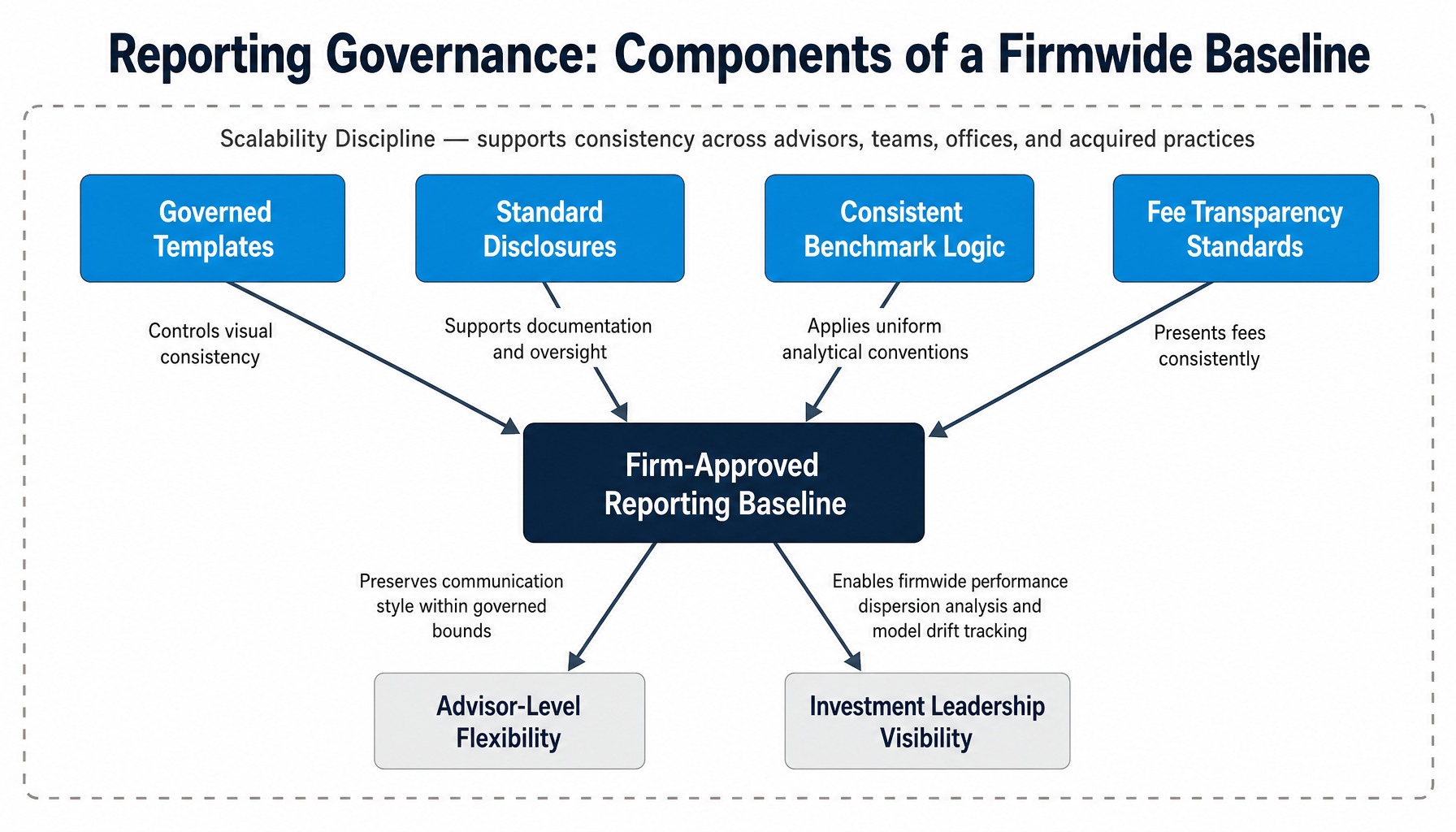
As advisory firms grow, adding advisors, teams, offices, or acquired practices, their wealth management client reporting processes tend to fragment. Different advisors may use different templates, apply different benchmark conventions, or include inconsistent disclosures. For a solo practitioner, this is a matter of preference. For a multi-office firm, it becomes a significant governance and scalability concern. Reporting governance is not a creative constraint; it is a shared analytical and presentation baseline that supports consistency, documentation, and the firm's own oversight processes.
Template, Disclosure, and Benchmark Consistency Across Teams
Establishing reporting governance is not about forcing every advisor into a rigid, identical format. It is about creating a firm-approved baseline that ensures every report includes standard disclosures, applies consistent benchmark logic, presents fees transparently, and uses firm-approved branding. A locked reporting template controls visual consistency, while a governed workflow controls who can modify analytical inputs like benchmark selection.
Consider a firm where a compliance review reveals that two advisors are using different disclosure language for the same model portfolio, and one advisor's template omits the firm's required benchmark comparison. This kind of drift is a common challenge for growing firms, particularly those that have integrated advisors from acquired practices who bring their own reporting habits. By establishing governed templates, firms can support their documentation and oversight obligations while preserving advisor flexibility in how they communicate with clients. It is fundamentally a scalability discipline, not a control mechanism.
Read more: Operational Visibility for Wealth Management Growth | VRGL
What Investment Leadership Needs from Firmwide Performance Data
Shifting the perspective from the advisor to investment leadership reveals a different kind of visibility need. In many firms, leadership is less focused on account-level performance surveillance inside client reports and more focused on how advisors are using approved analytical and presentation workflows across the firm. That can include visibility into proposal generation activity, usage patterns, and the consistency of client-facing materials across teams and offices.
In a common scenario, leadership at a multi-office RIA wants to understand whether advisors are using firm-approved templates and disclosures consistently when preparing comparative analyses and client-ready materials. If the firm's workflow is fragmented, that oversight can become manual and incomplete. A governed reporting and proposal workflow can help support more consistent materials and clearer visibility into how advisor-facing workflows are being used across the organization.
How VRGL Connects Comparative Portfolio Analysis to Client-Ready Presentations
The central challenge of wealth management performance reporting is the fragmented workflow that separates data, analytics, and client-ready presentation. Methodology choices, data integrity, household aggregation, and firmwide governance are often handled by disconnected systems and manual processes, creating gaps where time, consistency, and clarity are lost.
The VRGL growth platform supports a different part of that broader ecosystem. VRGL helps advisors move from statement extraction to five-pillar comparative analytics and branded proposals for prospective clients and existing client conversations that require portfolio comparison and presentation. VRGL's AI capabilities support statement extraction, while its portfolio analytics, comparative analysis, and proposal generation are delivered through traditional software workflows.
Rather than replacing a portfolio accounting system or ongoing performance reporting platform, VRGL supports the acquisition and engagement workflow around portfolio analysis and client-ready materials. Advisors and firms can use VRGL to:
- Extract data from existing statements and holdings documents with less manual rekeying.
- Evaluate current portfolios through comparative analytics across performance, risk, diversification, fees, and tax considerations.
- Create branded proposals and presentation materials that support prospective client conversations and comparative reviews.
- Apply greater consistency to templates, disclosures, and client-facing materials across advisors, teams, and offices.
VRGL supports the data, analytics, and presentation workflow around comparative portfolio analysis, while the advisor retains full responsibility for interpreting results and communicating their own recommendations within their fiduciary framework.
Conclusion
The quality of wealth management performance reporting is not determined by the precision of a return calculation alone. It is defined by the integrity of the workflow that connects raw data, rigorous analysis, and client-ready presentation. The methodology choices an advisor makes can shape a client's perception of success, while the quality of the underlying data determines whether the report is even credible. For complex clients, household-level views are not a feature but a necessity, reflecting how they actually think about their wealth.
As firms scale, these individual components become a matter of firmwide discipline. Firms that treat performance reporting as an integrated workflow unifying data, analytics, and governed presentation are better positioned to deliver the consistency and clarity that can support stronger client relationships and sustainable growth.
This article is for informational purposes only and does not constitute investment, legal, tax, or compliance advice. VRGL is a technology platform and does not provide financial advice, investment recommendations, or fiduciary services. Firms should consult with their own legal and compliance professionals regarding their reporting practices and regulatory obligations.
Frequently Asked Questions
1. What role does GIPS compliance play in wealth management performance reporting?
The CFA Institute's Global Investment Performance Standards (GIPS) are primarily designed for firms presenting investment performance in standardized ways, often in composite contexts, so many RIAs are not required to adopt them. However, some firms voluntarily use GIPS-aligned practices around areas such as composite construction rules and return calculation methodology to strengthen internal discipline and transparency. The specific GIPS requirements that apply can vary based on asset class, composite type, and the relevant provisions, so firms may want to evaluate GIPS as a framework rather than assume a single standard applies in every reporting situation.
2. How often do advisory firms typically deliver performance reports to clients?
Quarterly reporting remains a common cadence for many advisory firms, as it aligns with traditional review meeting schedules. However, delivery frequency can vary based on the firm's service model and client expectations. With many clients now able to access account data in near-real-time via custodial portals, some firms are re-evaluating whether formal quarterly reports are sufficient or should be supplemented with more frequent, on-demand updates. The optimal cadence is a firm-level decision balancing operational capacity with client needs.
3. How do fee-adjusted returns affect client interpretation of portfolio performance?
Presenting returns net of advisory fees can provide a clearer picture of a client's actual experience than reporting returns gross of advisory fees alone. Other costs may also affect the client's outcome, but they are not always handled the same way in reporting calculations. For example, fund-level expenses are generally already reflected in a fund's net asset value and reported performance, so they would not typically be added again as a separate deduction in a fee-adjusted return calculation. Clear disclosure of what is and is not reflected in reported returns can help clients interpret portfolio performance more accurately.
4. How can firms report performance on held-away assets they do not custody?
Reporting on held-away assets, such as a 401(k) or accounts at other institutions, typically requires extracting data from client-provided statements or, where available, through data aggregation services. This data must then be reconciled and integrated into the firm's primary reporting system. Firms may want to set clear expectations with clients that the data quality, timeliness, and level of detail for held-away assets can vary, which may affect the precision of the performance figures for those specific accounts.
5. What are the operational risks of relying on manual processes for performance report preparation?
Manual report preparation involving spreadsheets to consolidate data, format templates, and customize outputs introduces significant operational risk. This includes exposure to data entry errors, the use of inconsistent or outdated disclosures, and version control challenges across multiple clients and reporting periods. These risks tend to compound as a firm grows. The time advisors and staff spend on manual preparation can also reduce their capacity for higher-value, client-facing activities.